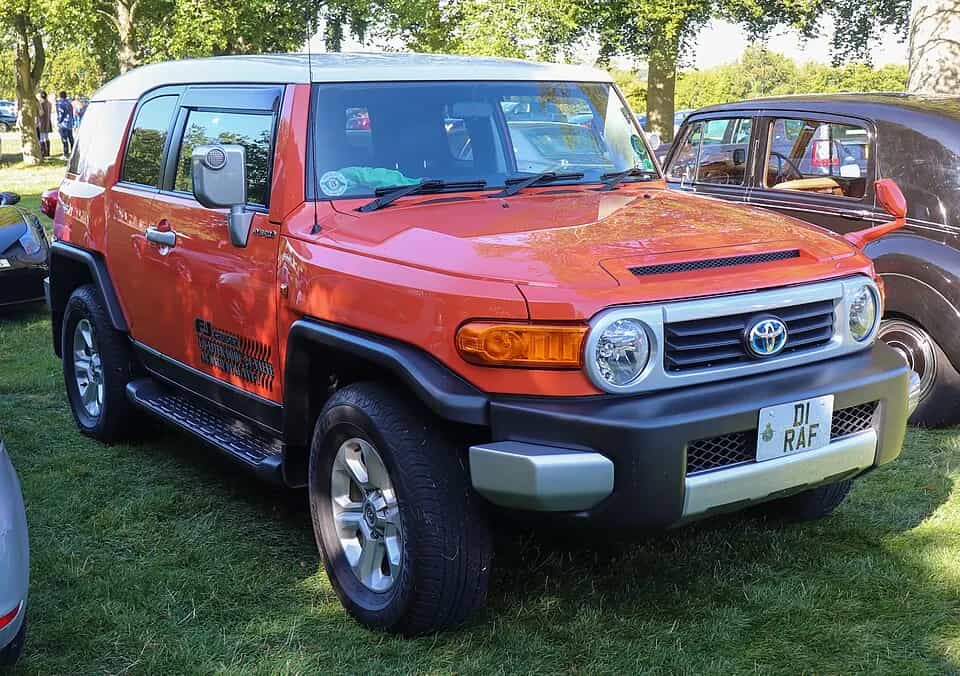
Toyota FJ Cruiser

Importing a used Toyota FJ Cruiser from the USA

Few modern Toyotas have become collectible as quickly as the FJ Cruiser. Styled as a deliberate homage to the classic FJ40 Land Cruiser, it combined retro looks with a serious body-on-frame off-road platform, and because it was never officially sold in Germany, importing a used example from the USA is effectively the only way to put one on European plates. The American market is where these trucks were sold in volume, so it offers the deepest choice of colours, drivetrains and condition. USCar Trader acts purely as an independent broker: you choose the FJ, we verify it and manage the import, with no dealer margin built in.

Toyota fj-cruiser – used car imported from the USA
Photo: Vauxford · CC BY-SA 4.0 · Wikimedia Commons

Generations at a glance

The FJ Cruiser ran as a single generation in the US from the 2007 to the 2014 model year, after which it continued in some export markets. It shares its ladder frame and much of its running gear with the contemporary 4Runner and the Land Cruiser Prado, which is a large part of why it is so durable. The most important mid-cycle change came for 2010, when the 4.0-litre V6 gained dual VVT-i and a power bump. Later years brought the sought-after Trail Teams special editions, upgraded skid plates and — from 2013 — different wheel and interior details worth noting when you compare VINs.

Powertrain lineup

Every FJ Cruiser uses Toyota's 1GR-FE 4.0-litre petrol V6. Early 2007-2009 cars produce around 239 hp; the 2010-on dual VVT-i version lifts output to about 260 hp and 271 lb-ft of torque. Two transmissions were offered: a 5-speed automatic paired with rear-wheel drive or part-time four-wheel drive, and a 6-speed manual that came exclusively with full-time four-wheel drive using a Torsen limited-slip centre differential. A rear locking differential and Toyota's A-TRAC traction system were available and are highly desirable for serious off-road use. The engine is timing-chain driven, not belt, which removes one recurring maintenance worry.

Trims in the US market

Body style is fixed: a chunky two-box, four-seat-plus wagon with rear-hinged half doors and a signature wrap-around windscreen with three wipers. Rather than distinct luxury trims, the FJ was sold in a base form plus option packages — Convenience, Off-Road and the range-topping Trail Teams editions — that bundle the rear locker, upgraded suspension, larger wheels and cosmetic touches. When importing, the presence of the rear locker and 4WD version matters far more to value than paint or badging.

The used market stateside

Supply in the USA remains healthy, though good examples are no longer cheap because the FJ has a devoted following. Typical cars now show varied mileage from moderate to high, and condition is the real variable: many were used exactly as intended off-road, while others led easy suburban lives. The best imports are honest, unmodified or tastefully modified trucks with clean frames and full service history. Sun-belt cars from the American southwest are prized for rust-free undersides.

Who should import one

The FJ Cruiser suits the buyer who wants a genuinely capable, mechanically simple off-roader with cult appeal and strong residual values, rather than an efficient daily commuter. It is ideal for overlanding, towing light trailers and standing out. Anyone prioritising fuel economy, rear visibility or a large boot should look elsewhere; the FJ trades practicality for character and toughness.

Key specifications

AttributeDetail (US-spec)
Body styleBody-on-frame SUV, 3 doors + rear half-doors
Engine4.0 L 1GR-FE V6 petrol
Power (2007-09)approx. 239 hp
Power (2010-14)approx. 260 hp / 271 lb-ft (dual VVT-i)
Transmissions5-speed automatic / 6-speed manual
DrivetrainRWD or part-time 4WD (auto); full-time 4WD (manual)
Off-road aidsRear locker, A-TRAC, Torsen centre diff (manual)
Ground clearanceapprox. 9.6 in (~244 mm)
FuelPetrol
Seating5
Lengthapprox. 183 in (~4,670 mm)
Towing (typical)up to ~2,270 kg (~5,000 lb)
Model years (US)2007-2014
TimingChain (maintenance-free interval)
OriginBuilt in Japan (verify by VIN/plant)

How reliable is it?

The FJ Cruiser has an excellent reliability record, and the 1GR-FE V6 is one of Toyota's more robust engines when serviced on schedule. The recurring weak points are practical rather than catastrophic: heavy fuel consumption, poor rear three-quarter visibility because of the thick pillars and small rear glass, and limited cargo space. Watch for frame and underbody rust on cars from snowbelt states, worn ball joints and lower control arms on hard-used trucks, and cracked exhaust manifolds on high-mileage examples. Off-road abuse can leave bent skid plates, damaged diffs or water intrusion, so a car that has clearly been mudded deserves extra scrutiny. Regular oil changes and timely coolant service keep these engines running well past 300,000 km.

What US models do differently

US FJ Cruisers run on miles, lack a rear fog lamp, and use amber-and-red US-style lighting that must be adapted for German type approval. Fuel is regular unleaded petrol, which is fine in Europe. Because the model was never officially homologated for Germany, there is no European COC, so registration goes through an individual technical approval. The exhaust emissions category and CO2 figure derived at the TUEV determine the annual Kfz-Steuer, which is worth estimating before you commit.

Seven steps to your import

Selection: you identify the FJ; we appraise it. VIN and origin check: the plant code confirms Japanese assembly and the exact build. Escrow: funds are held until the car is verified. Ocean freight: container or RoRo shipping to a German port. Customs clearance: duty and import VAT declared on arrival. TUEV / individual approval (Einzelabnahme): inspection and modifications. Registration: German plates issued.

Customs, taxes and costs explained

Key point: duty depends on the plant of build; only a VIN check secures the 0% rate. Import VAT of 19% applies regardless.

Import duty and import VAT are separate. The 0% EU duty under Regulations (EU) 2026/1455 and 2026/1461 applies only where the VIN proves US origin and the car ships directly within the window to 31 December 2029. The FJ Cruiser is built in Japan, so it will not usually meet the US-origin test — in that case the standard EU passenger-car customs rate, currently 10%, applies. On top of duty, the 19% German import VAT (Einfuhrumsatzsteuer) is always charged on the customs value plus duty. We never add a margin; the figures are the genuine charges.

German TÜV and registration

Expect to fit a rear fog lamp, adapt or replace headlights and side markers to European standards, convert the speedometer or document the reading, and have the odometer's mileage recorded in kilometres. Any aftermarket lift, wheels, bumpers or lighting must be documented and approved individually. The inspector will also verify tyres, brakes and emissions before issuing the approval.

The buyer checklist

Match the VIN to the title and body; obtain a Carfax or AutoCheck report for accidents and title brands; inspect the frame and underbody carefully for rust and off-road damage; confirm which drivetrain and whether the rear locker is present; check service history for regular oil and coolant changes; ensure the title is clean and lien-free; and test all four-wheel-drive functions and diff lock engagement.

Questions and answers

Can I register an imported FJ Cruiser in Germany?

Yes. With an individual technical approval (Einzelabnahme) and the required modifications, an imported FJ Cruiser can be fully registered on German plates.

Does the FJ Cruiser get 0% import duty?

Usually not, because it is built in Japan. The 0% rate needs provable US origin; otherwise the standard EU car duty (currently 10%) applies.

Do I still pay import VAT?

Yes. The 19% German import VAT applies to every used-car import, separately from any customs duty.

Which drivetrain should I look for?

The full-time 4WD manual with the Torsen centre diff, or an automatic 4WD with the rear locker, are the most capable and sought-after.

Is the FJ Cruiser reliable?

Very. The 4.0 V6 and Toyota running gear are durable; the main downsides are fuel use, rear visibility and cargo space.

What are the common problems?

Frame rust in salt regions, worn suspension joints on hard-used trucks, thirsty fuel consumption and off-road wear are the things to check.

Petrol or diesel?

US FJ Cruisers are petrol only, running the 4.0-litre V6 on regular unleaded.

How long does importing take?

Typically a couple of months from purchase to registration, including shipping, clearance and approval.

See more from Toyota in the Carhub, compare other rugged SUVs like the Jeep Wrangler 2-Door and the Nissan Xterra, or browse current FJ Cruiser listings.